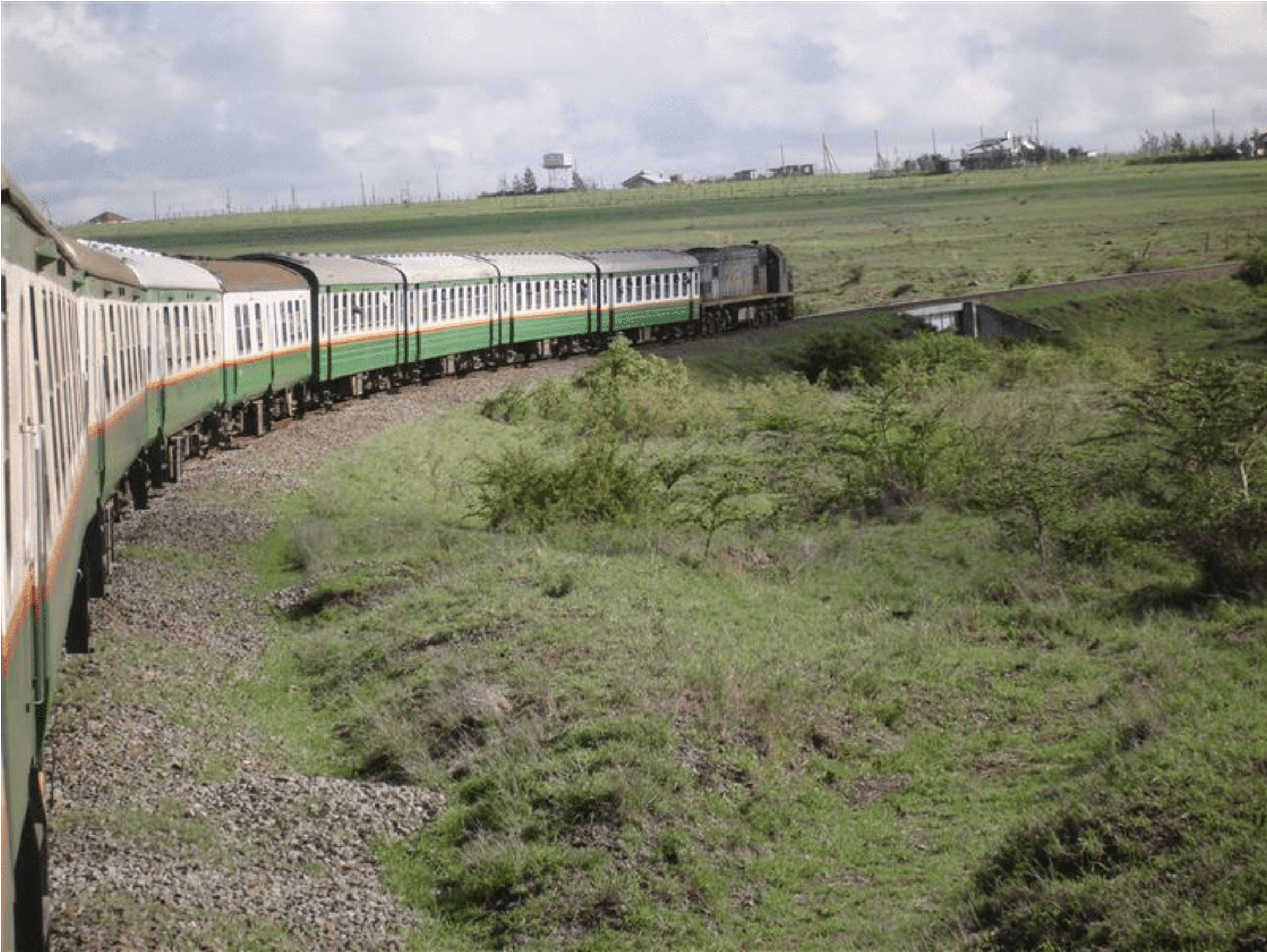
‘Which is the train to Mombasa?’ I asked the inspector at the barrier. He wanted to see my ticket, then pointed to the long green and white coached train stationary at the adjacent platform. My question was not really necessary since it was the only train, except for the one that went the other way on the same line to Kisumu. With two hours until departure and dusk settling over Nairobi, Ken and I decided the area around the railway station with its busy bus terminal, was not the best place for two muzungus who wanted to keep their belongings. So we fought our way through the crowds of people embarking or disembarking from the mass of matatus – 15-seat Toyotas that regularly fit in 20 or more – their ‘conductors’ yelling destinations and trying to attract customers into their vehicles. To travel on one is an experience of rapid mass transit devoid of the pedantic requirements of European safety or comfort – no belts, hard seats, no signals, bald tyres, the driver with his foot on the floor whatever the gear – just pay your 50 shillings, hold on tight and pray!
We walked along Moi Avenue using the cylindrical tower of the Hilton Hotel in the distance as a bearing towards the more affluent parts of town, our rucksacks tightly closed, arriving at Doorman’s for a cup of coffee. I turned my attention to another issue; I had omitted to bring the hotel confirmation. I owned up; ‘Ken, we’ve got rooms in Mombasa, but I don’t know which hotel.’
‘Let’s check the guide book,’ Ken suggested, clearly hoping something would stir my vacant memory. But it didn’t help so I texted home – perhaps Clare would be able find it amongst my emails – it would be embarrassing visiting each of Mombasa’s hotels asking ‘Did I book a room here?’
The engine was not a steam locomotive as I had romanticised but an old railway monster none-the-less; a huge diesel engine, powerful enough for the return journey when it would have to drag the train up nearly 2km of ascent from the coast back to Nairobi. No sooner had we found our 1st class compartment with its two bunk beds when Peter, the attendant appeared, full of attentiveness and advice, no doubt setting himself up for the tip he would request later. ‘Keep the door locked once you’re inside,’ he said, ‘because there are thieves on the train.’
In good African tradition, we didn’t leave at the scheduled departure time of 7pm but it didn’t matter because Ken and I, both in our fifties, sat like two little boys grinning with excitement to be escaping Nairobi’s grip like spies vanishing into the night on one of the world’s great railway journeys.
Eventually the train heaved and clanked into motion, gradually accelerating to its cruising speed of about 30 miles an hour, which it maintained for most of the 15 hour, 330 mile journey to Mombasa, uninterrupted except for a few stops to make way for passing freight trains. Just as my stomach reminded me we hadn’t eaten, the bell rang for dinner – well, someone walked the coaches bashing a set of chimes – and we made our way to the restaurant car. What greeted us was a scene from the 1920s as we entered the world of Hercule Poirot and Murder on the Orient Express. Industrious, white-clad waiters served soup from silver terrines as ceiling fans worked in mechanical synchronisation to circulate the warm night air. The table was laid with Kenyan Railways crockery and a silver butter dish. We joined the other diners, mostly Westerners capturing the quaint atmosphere with their digital cameras, but there were some Kenyan families on their way to the beach. It was as if we had entered a time portal that had warped us back to Kenya’s colonial past – the days of White Mischief and Out of Africa, when Europeans ruled the roost and lived the life of Riley. Now, quite rightly, we paid for the privilege ($130 return), and instead of subservience, the waiters attended us with friendliness and confidence. But it was nice to think that time had not changed the essence of rail travel – dinner served as you amble along in a delightful restaurant car to the buzz of pleasant conversation is civilisation at its best – and time certainly hadn’t changed the upholstery on which we were sitting. My phone buzzed – a text from Clare – we now had rooms in Mombasa.
It was a sleeper train but we didn’t sleep. There was the sound of children crying next door, excited tourists planning their Mombasa campaign, and the relentless lumbering, clackety-clack of the train swaying on the loosely bolted track, like an old ship on an extended slipway grinding its way down to the sea. I tossed and turned until the breakfast bell. By then it was light and the views were of rolling hills, intermittent villages with their children waving us on, and occasional views of the train itself as we snaked our way down towards the coast.
Back in the restaurant car two young Dutch women told us of their work in a Kenyan orphanage in Naivasha. They spoke fondly of the children as their babies and were frustrated by a well-to-do Kenyan lady who had used her connections together with false documents to have three of the children moved to her home to attract government allowances. The conditions there were bad because instead of spending the money on the children it went on good living, expensive clothes and fancy hair-dos. Another tale of corruption, the topic of nearly every news report on KTN or NTV and perhaps the number one enemy to Kenya’s progress. Tales of Naivasha brought mixed recollections – that vast and beautiful lake in the dramatic Rift Valley with its varied birdlife and partly submerged hippos is now surrounded by huge greenhouse complexes growing all-year-round flowers for M&S back home. The flower business has brought jobs and townships have sprung up around the lake, but who knew the environmental impact as they used the lake for irrigation and as a repository for chemical and human waste?
We stuck our heads out the window for the last part of the journey. The air was hot and sultry as the train chuntered past children shouting greetings from mud houses with thatched roofs, the density of the buildings increasing as we approached our destination. The station resembled something from The Railway Children with a sign that read Mombasa Alt. 18m; a platform with canopied roof, long abandoned first, second and third class toilets and, by the entrance, an old ticket office. After showing our tickets, we were out in Haile Selasie Road keen to explore Mombasa.
The crossed elephant tusks on Moi Avenue looked good from a distance, like Bagdad’s crossed swords, but close up they were poorly painted, bolted-together aluminium sheets. Mombasa certainly felt very different from Nairobi and not just because of the climate. We had passed a temple and a mosque and were to see many more. There was a diverse mixture of faces – African, Asian, some Arab looking in headscarves or wearing the buibui – a black floor length gown and head covering. The buildings in this part of town were a charming mix of old British colonial, retro offerings from the 50s and 60s, and some modern glass-metallic hulks.
The Castle Royal, reputedly the best hotel in town, lived up to its reputation. Its open porticos funnelled a welcome breeze through its corridors, and its ground floor coffee shop which opened onto the road was an enticing oasis to ward off dehydration. It also attracted a crowd on the pavement outside to view the wide-screen TV each time an English Premier League game was showing.
In the old town, Mombasa’s architectural pot purri was augmented by Arab and Portuguese houses and shops of stone and wood leaning together to form narrow streets, interrupted here and there by a white-walled mosque, all of it emanating a North African aura. It was dominated at one end by the black-stained honey-ochre walls of the Portuguese Fort Jesus, an imposing fortress that guarded entry to the harbour – not many ships would have braved the channel with the fort’s big cannons pointing out towards the northern mainland. It had changed hands multiple times and at one stage withstood a siege against the Omanis for almost three years, during which time most of the Portuguese and their Swahili allies had died of starvation or plague. Despite its cosmopolitan quaintness however, the old town, in fact the whole of Mombasa, exhibited an air of decay – its historical treasures left to crumble and rot; surely an opportunity lost given the criticality of tourism. One of the reasons, I read, was that much of the shipping had moved to Dar e Salaam and Mombasa’s port is now a poor shadow of its former self, the loss of trade clearly impacting the rest of the town’s economy.
‘Where would you like to go? I’ll show you’. An Arab-looking Kenyan in robes and a taqiyah (round cap) had latched onto us and was trying to show us around as if he was doing us a favour. After an annoying 10 minutes of commentary that we hadn’t asked for and for which I knew there would be a fee, a curt ‘We know the way!’ eventually got rid of him, after which we proceeded to get lost in the maze of narrow streets. We passed small curio shops, stalls selling fruit or frying food, frontages with finely crafted woodwork now decaying, and the entrance to the dhow harbour where we didn’t pay to get in because there were no boats. Veiled women starred at us and children learning the Koran looked up from their recitations. Amidst it all painted large on a wall was the Liverpool badge, and hanging elsewhere a banner for Arsenal. Our escape from the old town was by way of the Tarboush Café on Makadara Road for a curry lunch. Later we sampled more Indian fare at the Shehnai Restaurant which specialises in Mughlai dishes. The mutton cooked in spices and pickles was delicious, and the atmosphere warm as large Indian families came to dine.
Walking around town revealed some vestiges of the privileged past – the Mombasa Sailing Club and, along the seaward shore of the island, the Mombasa Golf Club. Near the golf course, idyllically framed on a white cliff by the sea, a wedding party was having a photo-shoot and their album now includes the mugs of two smiling muzungus. The coastline was pretty, although closer inspection of the sharp coral shore revealed it to be strewn with rubbish. On a promenade along the cliff top vendors were selling coconuts and fried cassava chips. The prom gave way to a forest of baobab trees, some with distended trunks wider than a truck. The view beyond was of Likoni on the south coast and of two ferries crossing mid- channel full to the gunnels with cars, lorries and people. The dock was a busy market and matatu terminal funnelling commuters and shoppers onto the island.
Nyali Beach to the north of Mombasa island is a long stretch of white sand flanked by palms and well camouflaged hotels on one side, the Indian Ocean and a couple of warships on the other. Given the near-deserted beach and the climate, you could be forgiven for thinking you were in the Caribbean, except that there they had rid themselves of their pirates a couple of centuries ago whilst here military helicopters buzzed back and forth as cargo ships passed nervously up the coast towards Somalia.
You can see the waves breaking on the barrier reef a mile or so out to sea. Ken and I got sunburned snorkelling nearer to shore over a pretty part of the inner reef with brain and potato coral, colourful fish and eels. With no shower to rid ourselves of the sea water, the best we could do was to wash each other down with a garden hose behind the dive centre.
Haller Park is an excellent attempt at restoring the environment of an old limestone quarry, and immediately reminded me of the Eden Project in the UK. Ignoring the huge Bamburi Cement Factory next door, entering the park is to step into a lost world of lush tropical greenery, ponds with crocodiles, a lake with birds and hippos, tree-shaded glades with basking elands and tanks teeming with silver-sided tilapia fish. We met some friendly giraffes that you can feed, inquisitive tortoises the size of sit-on lawnmowers that like their necks rubbed, and several casks of Kenyan snakes that stayed were they were, thankfully. The young guide who showed us around was justly proud of their achievements.
Mombasa station looked rather forlorn in the dark but there was a sense of anticipation as we sat gulping our satisfyingly cold Tusker beers at the platform bar, served by the train staff who greeted us as long-lost friends. On the wall hung some old black and white photographs of the Mombasa waterfront and Mount Kenya, which although sadly neglected looked authentic and, as Ken commented, were probably worth a fortune.
We boarded and, after another fine dinner, slept soundly. At breakfast a Swedish couple told of their ongoing attempt to adopt a gorgeous eighteen month old baby girl – a Luo as dark skinned as they were pale, and clearly enjoying the devoted attention of a mum and dad after life in an orphanage. But the process was arduous – they had begun back in November and were likely to have to remain in Kenya until June for completion of all the paperwork – no doubt if you threw Madonna-sized amounts of money at the right people it could be facilitated faster. I wondered how the little girl would get on in cold, tidy and efficient Sweden – accepted I hoped, certainly loved by her new parents.
Sometime during the night Ken said that we must have passed through Tsavo. It was here that a large number of the Indian workers (imported by the British to build the line) and native Africans had been eaten by two lions – 135 of them! They now stand stuffed (the lions not the Indians) in the Chicago Field Museum of Natural History, stopped in their tracks (or Kenya Railway’s) by Engineer Lt. Col. John Henry Patterson who in 1898 finally hunted them down and shot them dead.
We passed old signal boxes and small halts where traffic waited to cross the line and the coming of the train was still a wave-worthy event. There were escarpments in the distance and, on the Athi plains we saw zebras and antelopes. The first signs of Nairobi were the slums that shadow the line before the modern skyline appears. We were back.
So would we do it again? Absolutely. In fact I’ve heard you can take the train the other way towards Uganda overnight all the way to Kisumu and Lake Victoria.