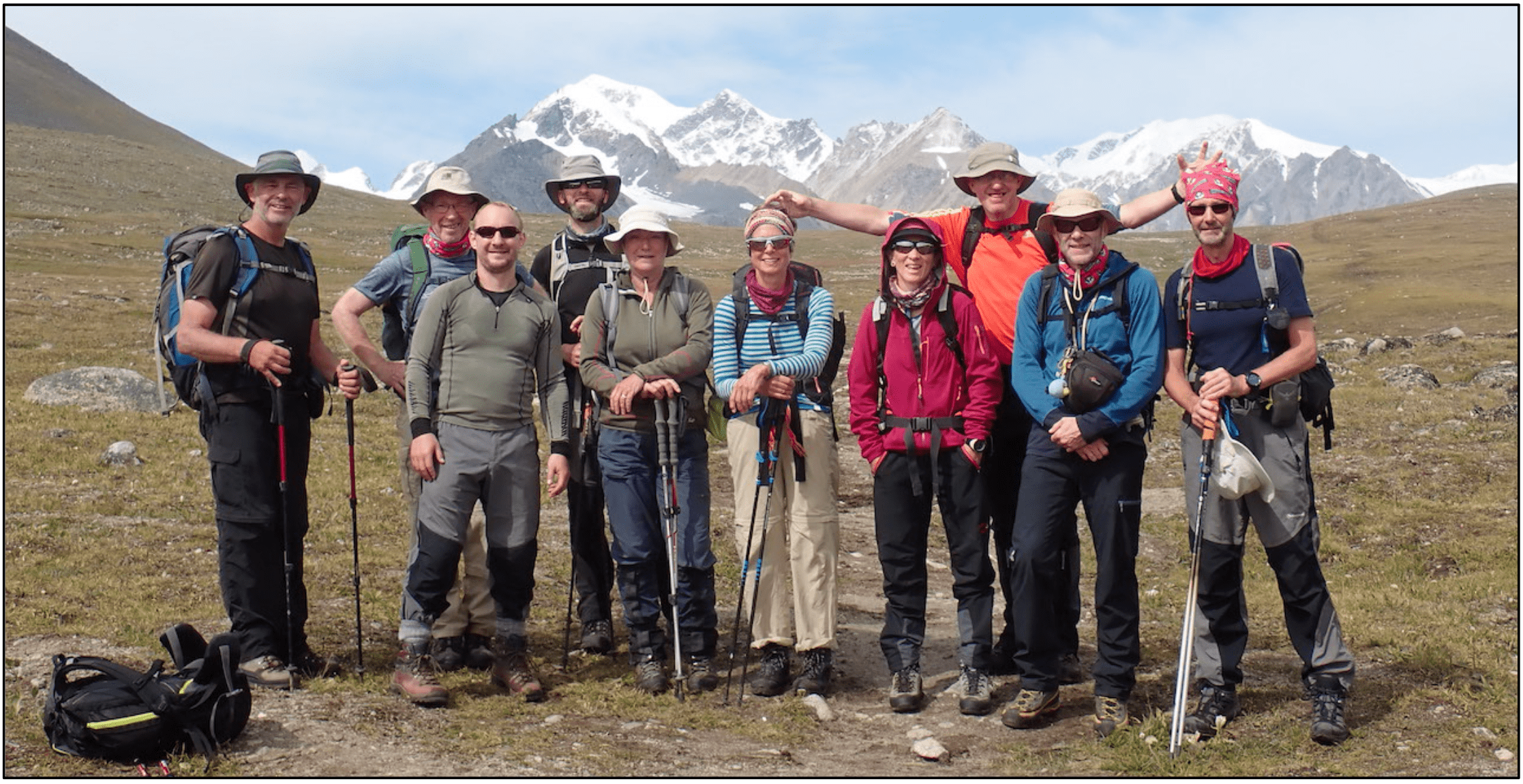
4 am Monday morning and the team, half-awake, gathered at Chenggis Khaan International Airport, Ulaanbaatar, soon reinvigorated by strong coffee and ready for the journey west. That was after paying some thousands of Mongolian Tögrög for excess baggage, but in reality, only a few pounds each. We flew over an empty country – a population of around three million in an area three times the size of France – to its mountainous borders with those powerful and petulant neighbours, China and Russia.
In Ölgii, our early arrival meant we had to wait for breakfast until the hotel’s restaurant had opened, but it was worth it for the fried eggs (forget the Spam) and good coffee, the last our intrepid guide Gana told us, we would get for a while. We scoffed at the three Russian-built vans that were to take us and our gear into the mountains; old, battered and battle grey, they resembled squat versions of the docile British Dormobile. But we soon learnt to respect their no-nonsense tackling of Mongolia’s unforgiving terrain. Tearing along dusty tracks, bouncing over boulders, up and down impossibly steep slopes, over rickety wooden bridges and through deep rivers, coaxed and bullied by their skilful drivers, whom we nicknamed Luis, Max and Sebastian after Formula One’s best. Troublesome carburettor, broken fan, clapped-out radiator, broken suspension spring, overpowering petrol smell – no problem, given the ingenuity of our drivers and a roll of Scotch tape.
North out of Ölgii there were no roads as we would describe them, just multiple tracks going in the vague direction of travel. Along these we trundled, the drivers racing side-by-side at times, we bouncing up and down bumping our heads on the roof and windows for six hours – our ‘Mongolian massage’ as Pete called it. Steve offered us a quiz on that first night in camp but Monica said, ‘Our brains are still too shook-up from the ride.’ We slept in small two-person tents, a puzzle to erect at first but soon we could get them up or down in minutes, and proved a cosy retreat after a tough day’s trekking.
Tuesday was our first real day of hiking, a gentle walk up to the pretty Baga Turgen waterfall, only a few kilometres from the border with China, which explained why we had to check in at the local military base. It was a chance to get stiff legs moving and to start the acclimatisation process for higher altitude. Of more significance was the subsequent game of Frisbee, which some young Mongolian bystanders found intriguing – why throw a floppy plastic plate at each other? – and some of us found frustrating trying to catch it.
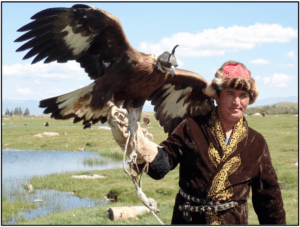 Driving out we stopped to meet a family of eagle hunters – a father and son with two large female eagles tethered by the lakeside, used during winter to hunt fox. Wearing a protective glove, the weight of one of them on an outstretched arm was like holding up a small dog; their talons were hand- sized and the span of their outstretched wings phenomenal. We enjoyed typical Mongolian hospitality, being invited into the son’s ger and offered generous amounts of curd, strong tasting cheese and other specialities. In another ger we watched as young people rolled felt (for the sides of gers) in the traditional way, enjoying each other’s company as they undertook this necessary task. We hiked 5km at the end of the day to the banks of the Baga Turgen River to meet our camels, their Kazak herders, and a big black dog that looked as if it hadn’t been groomed since birth.
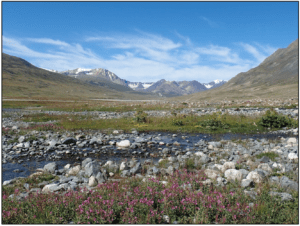
On Wednesday, we followed the river valley into the hills, scrambling to skirt around deep bogs and taking our boots off a couple of times to ford streams. The camels caught us up at lunchtime then went ahead to set up camp in Bear Valley. After shedding their loads, they were untethered to graze freely, which we thought was nice, until they took off back the way we had come and eventually disappeared over the horizon. Later, we were concerned to see their herders trying in vain to spot them with binoculars. Dave said, ‘It’s okay, we can carry our 15kg bags.’ I wasn’t sure I could, at least not very far. But apparently two herders had set out on horseback to find them and, miraculously, by morning they were happily grazing on the hillside above us, only to be skilfully driven down by a single rider.
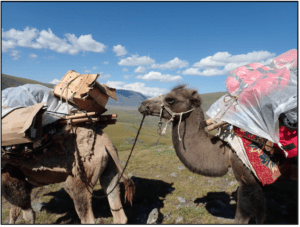 Thursday was a tough day. Our camels brought us lunch, which we needed to complete the 1,000m ascent that led us up onto Tahilt Pass at 3,100m. This vantage point gave us great views of the high snow- capped peaks, including our target, Malchin. On arrival at Black River, after a hard 20km, we were charged and bleated at by three lively guard goats, to which Emmanuel enthusiastically replied – ‘baaah!’
 The Mongolian language is difficult – after nearly two weeks I can only say one word badly; ‘ba- yar-la-laa’, which means ‘thank you’. Gana told us of Mongolians teaching westerners phrases purposely incorrectly: ‘How is your wife? I want to sleep with your goat’, which generated some offended reactions when they tried them on the locals.
One of the joys of trekking is the conversation on the trail. With Carol about family, Nottingham and Scotland. With Steve and Ian on shared experiences in Nepal and Ethiopia. With Monica and Emmanuel about pharma and medicine and the ups and downs of living in Switzerland. With Nick about business and travelling in Asia. With Dave on mountain rescue and the English Lakes (even if there is only one of them, the rest being ‘waters’). With Nic about global migration, humanitarian aid and injured Achilles tendons. With Pete, my long-suffering tent mate (who kindly brought us tea almost every morning) on our children, mountaineering and living as expatriates overseas.
Friday was an easier day with the camels bringing us sushi for lunch. Talking of food, we were catered for in the most amazing way by our friendly cook and her hard-working assistant. Mutton stew, momos, pizza, spaghetti Bolognese, chips and potatoes, pasta and rice, tasty soups, fruit and chocolate, with eggs and sausage, porridge, muesli and semolina for breakfasts. All prepared on a double-burner in the small cook tent.
We arrived in the pleasant White River Valley with its ranger station, and, importantly, a neat seated toilet in its own little hut. We rested in the valley the whole of Saturday, just as well since there had been a storm overnight and it rained hard most of the day, producing a perfect rainbow across the width of the valley.
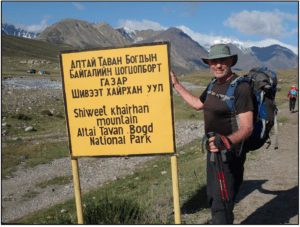 On Sunday we crossed the river to enter the Altai Tavan Bogd National Park, and trekked the 18km to base camp at 3,130m. Set against a clear blue sky, the mountain views improved all the way.
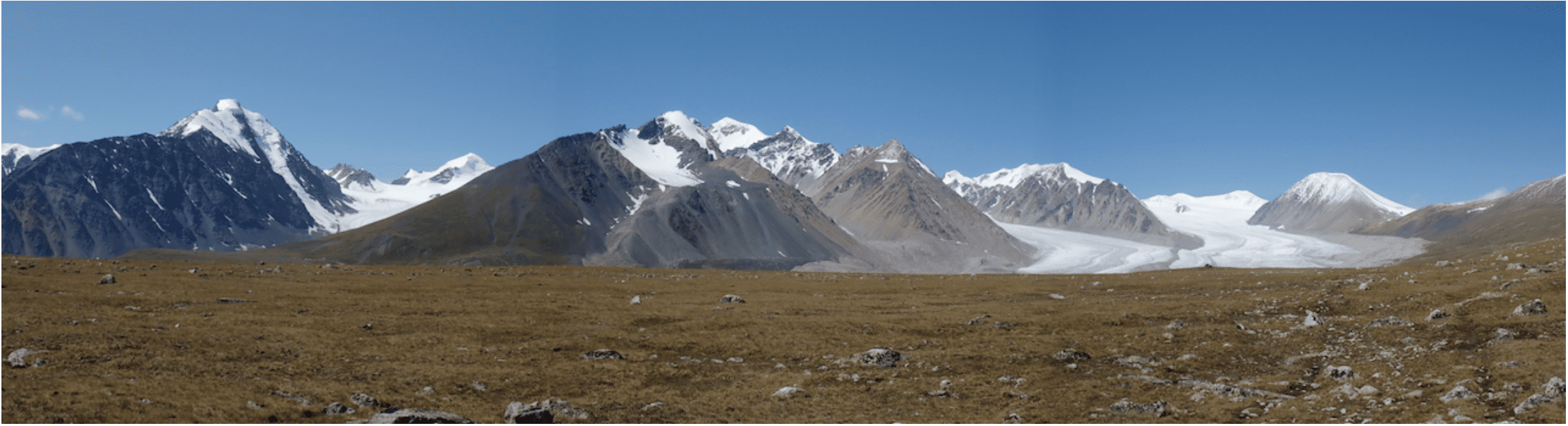
Base camp hosted at least four other groups and the long-drop toilets there were best avoided. But the vista from the top of the adjacent lateral moraine, taking in the Potanii glacier, Malchin, and Mongolia’s highest peak, Khuiten (4,374m), was astounding. That evening, Gana told us of a horse riding job he had applied for when studying in the UK. It was in Kemble, Gloucestershire, and the owner asked, ‘Can you ride?’ Gana jumped on the horse and galloped off. He got the job.
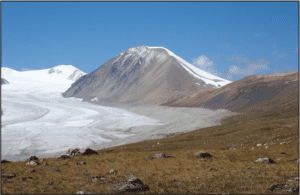 Another Monday, another 4 am gathering of the team. Six of us set off with Gana and several guides for the summit of Malchin in the pre-dawn wolf-light. I for one was excited and nervous in equal measure. It was 7km to the mountain and the first section of ascent onto its shoulder. Then we made our way up its formidable scree- coated ridge. I said to Pete, ‘This isn’t a mountain, it’s a pile of stones,’ as we trudged over loose rubble and rocks. We kept losing the path, sighting instead on Emmanuel and Monica, Steve and Dave up ahead. Puffing and grunting, we reached 3,800m; ‘It’s only another Boxhill or so,’ I said, using that 150m Surrey hill as a measure. After a brief respite, the next section of the ridge was steeper and presented larger rocks and boulders with more snow. But as it levelled off we got our first glimpse of the summit which, with the encouragement of the others descending, spurred us on.
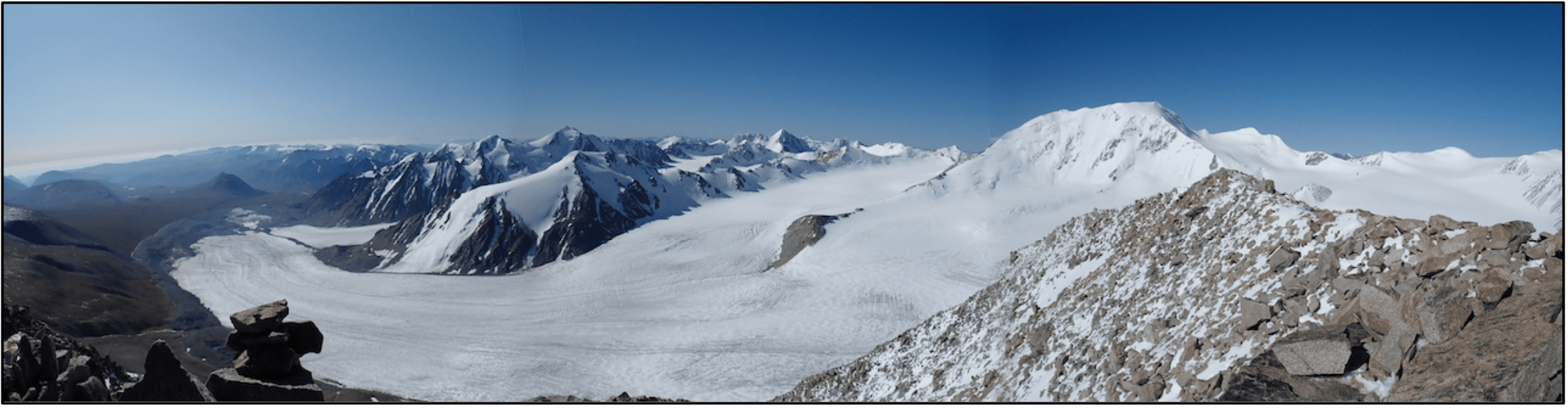
The last section took us up a steep snow slope to the top at 4,050m, where we were awed by the panorama of Mongolia’s Altai Tavan Bodg mountain range with some of the most remote 4,000m peaks on the planet. Following the line of the ridge ahead and a little to our left stood Khuiten, white and majestic, and we could just make out a few climbers on its ridge. Below us the huge glacier flowed south and lapped around the other peaks like a sea of ice. Malchin’s ridge lay behind us, reminding us of the four hours it had taken to get here. In the distance to our right ran an extensive mountain range in Russia. We took photos and drank in the view, as well as some water, enjoying the moment of achievement.
We descended with Gana and Toko, and two others of our Mongolian team, taking the northern snowy side of the mountain as the easier route down, gleefully entering Russia without a visa. At one point we slid down on our bums like kids tobogganing in the snow – we have an action video of Gana to prove it. ‘Where’s the base camp gone?’ asked Monica; 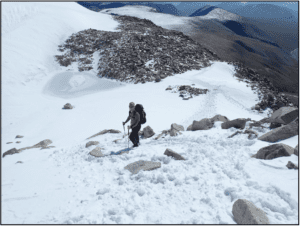 he 7km back seemed to have got longer. Tired from the morning’s exertion, and after a well-earned lunch, we packed up the tents and kit and hiked out, another 18km back to White River Valley and our favourite toilet. That evening we bade farewell to our camels and their herders and, too tired to quiz, slept like the dead.
Tuesday we walked south down the valley, passed ancient burial mounds, to meet the vans at a pleasant viewpoint for lunch (if you ignored the incessant mosquitoes, who had also stopped for lunch – us). A bumpy ride took us to the outskirts picturesque Tsengal, where we pitched tents for the last time by the river across from the town. Nic led our appreciation for the drivers and the catering team, resulting in handshakes, hugs and team photos.
After dinner the drivers found wood and built a fire, using petrol to ignite it, then passed around best Mongolian vodka so we were warmed inside too. The Mongolians sang tunefully – Gana told us they had two hundred songs about mothers and another two hundred about horses. Pete said, ‘There’ something very primeval about sitting around a blazing fire,’ as we all starred with melancholy into the flames. There was certainly something primeval about our rendering of ‘Hey Jude’, as we strained to hit the notes, reading the verses from Pete’s smart phone. A full moon cast its gentle light over the town and river as we retired to sleep in our peaceful meadow.
Wednesday saw us undertake the cross-country ride into Ölgii, where our reward was good coffee and wifi in a neat coffee cum bookshop. Then it was a long and tiring four- hour drive (on new metalled road, thankfully) to Khovd. Things looked up on our arrival at a delightful ger camp just out of town. Nick’s single was like a hobbit dwelling and our double was perfect. That first shower was amazing, even if the water was cold. Pete and I stripped the shelves of the local supermarket so we could all sit out and enjoy cold beer and cola, and munch crisps and Pringles, biscuits and Russian ‘Arctic Gold’ chocolate.
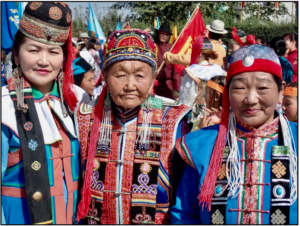 On Thursday morning there was time to visit the attractive and well-kept Buddhist monastery and then crash a traditional costume competition in the town’s main square, where people had arrived from different provinces, donning colourful clothes and flags and enjoying the festive atmosphere. It was a much-delayed flight that returned us safe to Ulaanbaatar for a late-night burger binge in the restaurant of the comfortable Corporate Hotel.
Gana and his team (his niece and nephew, Btse and Toko respectively, and the drivers, cook and assistant) proved to be exemplary guides for our Mongolian adventure: keeping us safe, leading us across the land, smoothing over bumps in the itinerary, picking the only rainy day for our rest day, finding us good coffee, and bringing us back mainly intact.
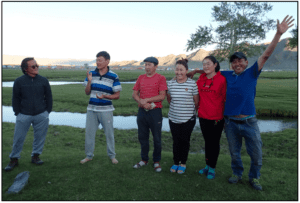 Everywhere we’ve ventured in Mongolia, we have seen an ancient people wedded to this beautiful and harsh land. As depicted in Conn Iggulden’s books on the life of Chinggis Khaan, we have observed it in the way they tend their livestock, ride their horses, cherish their easily moveable gers, roll felt, tie baggage to pack animals, and hunt with eagles. We have trekked this land, climbed its passes and mountains, tasted its mutton, stayed in its gers, and enjoyed the warm hospitality of its people. As Nic stated in her fitting tribute to our drivers and cook, it has been an absolute privilege.